Day pass: 6900 HUF
Discounts available
The day pass is valid for all events on the given day. For performances with limited capacity, please reserve the time slot of your choice.
Created with Ivana Jozić, Alen Sinkauz and Nenad Sinkauz
What does it mean to be a witness? To participate tacitly in violence?
A woman dancing in the sweaty, partying crowd suddenly recognizes the DJ. She carefully studies his movements, comparing them then and today, and she gradually makes out the face of a war criminal who was never convicted: “the man who kicks the dead”.
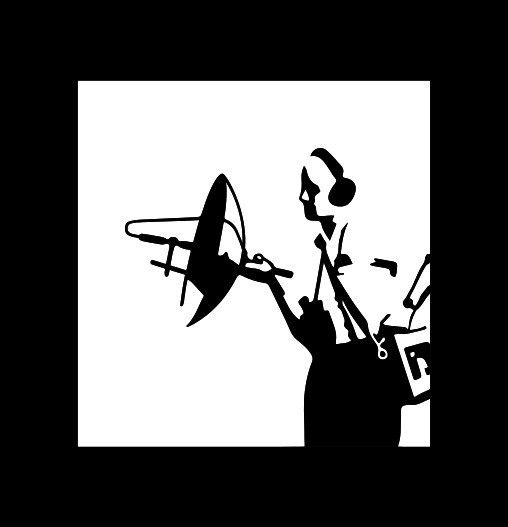
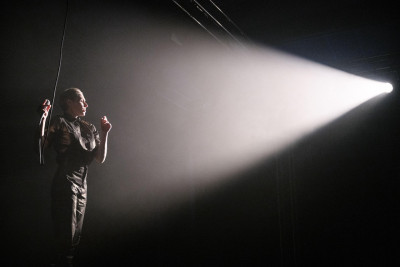
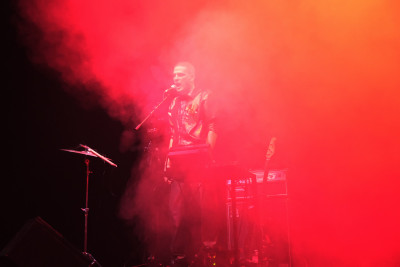
The starting point of APHASIA is the question of complicity in war crimes. Artist Jelena Jureša examines this issue with a war photo taken in Bosnia in 1992. It shows a Serbian paramilitary soldier wearing combat boots and kicking a woman lying on the ground. The same man turns out to be a DJ in Belgrade’s Goa scene thirty years later. In her exploration of this man’s identity, Jureša finds an expression for the unspeakable. The audience becomes a co-player of the evening set in an immersive club atmosphere. The musicians Alen and Nenad Sinkauz and the dancer Ivana Jozić stand on pedestals; the space is filled with ambient and techno music and Jozić’s macho gestures. The spectators become witness to the war crime APHASIA is about.
The medical term ‘aphasia’ describes the inability to form words and sentences. For Jureša, the title is an effective analogy: how does collective memory come into being and how do we find a language for it? How are war crimes and guilt dealt with? In the course of this haunting evening, it becomes increasingly clear that those questions not only apply to the Yugoslav wars, but are just as relevant to the current war in Ukraine and Gaza.


Concept and direction: Jelena Jureša
Performers: Ivana Jozić, Alen Sinkauz, Nenad Sinkauz
Choreography: Ivana Jozić and Quan Bui Ngoc
Music: Alen and Nenad Sinkauz
Sound design: Hrvoje Pelicarić
Text adaptations: Asa Mendelsohn, based on a monologue by Barbara Matejčić (Aphasia film and film installation, 2019)
Dramaturgical advice: Thomas Bellinck and Sara Oklobdžija
Film archives: Royal Belgian Film Archive (CINEMATEK), Filmarchiv Austria, International Criminal Tribunal for the former Yugoslavia (ICTY), Österreichische Mediathek, ZDF archive Berlin
Video concept and editing: Jelena Jureša
Visual effects: Dejan Šolajić
Set design: Stef Stessel
Light design: Koen Raes
Costumes design: Anne-Catherine Kunz
Costumes realisation: Salvatore Pascapè
Scientific advice: Christophe Busch
Technical director: Simon Neels
Technical support: Maxim Maes
Programming: Merel Vercoutere (KAAP)
Project coordinators: Sandra Raes Oklobdžija (ROBIN) & Rolf Quaghebeur (KAAP)
Production support: Kaat Balfoort, Jachym Vandenabeele
Production: KAAP in collaboration with ROBIN
Coproduction: Kaaitheater, Kunstenfestivaldesarts, ROBIN, De Singel, Workspacebrussels, Hannah Arendt Institute
Developed in Co-laBo
 |
Flanders – State of the Art |