Bildung
Opening: 20 November 2026 (Friday) 7pm
On view: 21 November – 13 December 2026
Opening remarks by art historian Monika Perenyei
Artists: Viola Fátyol, Péter Forgács, Virág Lődi, Little Warsaw (András Gálik – Bálint Havas), Bence György Pálinkás, Nóra Szabó
Curator: Zsolt K. Horváth
Free entrance
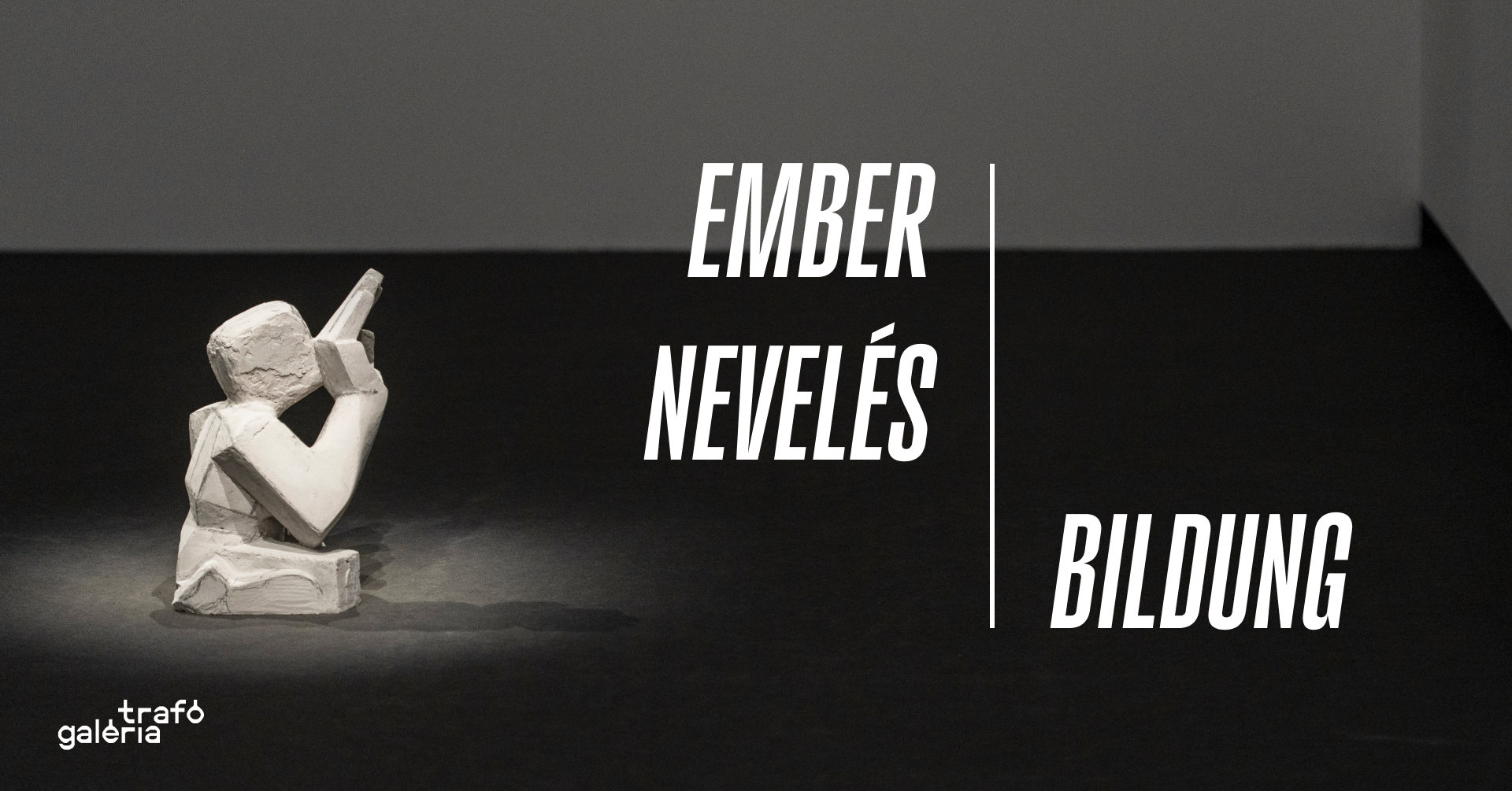
The exhibition titled School on the Horizon, which opened this spring in the exhibition hall of the Pannonhalma Archabbey, is now on view at the Trafó Gallery with slightly revised content. This is because the altered spatial layout presents the previously exhibited works in a different light, giving the entire exhibition a new focus. The more literary title, which referenced Géza Ottlik’s novel has been replaced by Bildung—a more austere concept rooted in the fields of pedagogy and the philosophy of art. This German term, encompassing education, cultural enrichment, and human development, originates in Enlightenment thought and refers to the changes taking place in a child’s mind, body, and emotions—that is, in their personality development. Bildung is a universal pedagogical ideal based on the premise that community-based acquisition of knowledge and the arts refines human personality, improves our social relationships, and nurtures our cognitive and emotional capacities.
The exhibition does not draw a sharp distinction between historical and contemporary phenomena, for it is the needs of the present that select from the archives of the past, and whatever captures our interest today therefore holds significance. The final third of the 19th century was marked by knowledge production in the natural sciences, with the scientist-teacher at its center. In the three years following 1945, the journal Embernevelés brought together pedagogues and psychologists who believed that a school grounded in the principle of justice prepared the way for a more democratic society. From the mid-1970s onward, within the framework of an increasingly declining political system, numerous artist-teachers took advantage of institutional opportunities that emerged in the aesthetic education developing at the intersection of the arts and pedagogy. However, these experiments also serve as a critique of today’s utilitarian school system. The latter, in fact, serves the social expectations of parents rather than focusing on the child’s abilities and interests. Thus, instead of a freer, more equitable, and more democratic environment, inequalities have emerged, dividing members of society.
The history of modern pedagogy is a history of attempts to eliminate various injustices. However, as philosopher György Márkus put it, “this ideal is moving further away from us the closer we approach it. Our modern world will endure only as long as it can continue this Sisyphean task”. Throughout history, the school has, of course, been the subject of much deserved criticism. Our goal is to explore the significance of Bildung and community-based self-education through examples from the school’s history, which were shaped by the humanities and the arts. “It was these bonds of unconscious union that held us knotted together,” as Géza Ottlik writes in his novel School at the Frontier, “something produced in us like a kind of secretion— buttermilk or rosin—that oozed out of wounds, strained muscles, pain, endeavor, and made it possible for us to live. Something that was less than friendship and more than being in love. (…) But we knew that over and above, all of us were playing out our own separate tournaments with our own separate destinies. (…) This was the reason why our bonds were stronger and more durable than those binding together mountain climbers and lovers, because knowledge of this was woven into them from the very start.”
Organized in collaboration between the Faculty of Arts at Budapest Metropolitan University, the Pannonhalma Archabbey and the Trafó Gallery, this exhibition explores the crisis facing schools today around the world and the possibility of renewal. Does the desire to build a freer, more equal, and more democratic society still live within us at all? This, in fact, is the key issue for a freer, more equal, and more democratic school. If that desire no longer lives within us, then the school of modernity will disappear from the horizon once and for all. However, the works of art and objects presented at the exhibition were made in the belief that this school, which has weathered so many crises, is capable of renewal, and that we are committed enough to roll the great Sisyphean boulder of pedagogy uphill again and again.
The exhibition is organized in collaboration with Budapest Metropolitan University, Trafó Gallery and the Cultural Board of the Pannonhalma Archabbey.
Curatorial assistant: Dalma Kovács
Research assistant: Fanni Tóth
Supported by: Káli Kövek