4.900 HUF (full price)
All discounts and Trafó pass valid.
The date of the premiere has changed due to the availability of the final cast.
Tickets purchased for 22 October can be changed to any other performance dates or will be reimbursed. Please contact: jegypenztar@trafo.hu
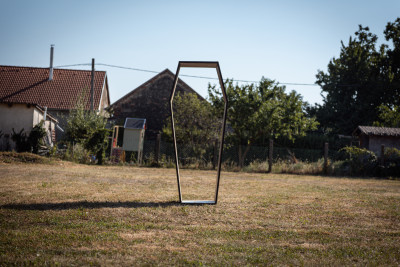
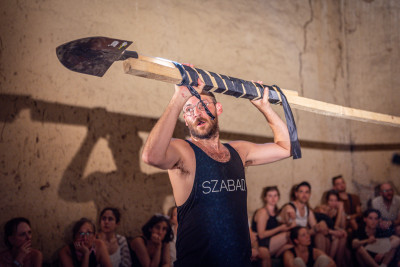
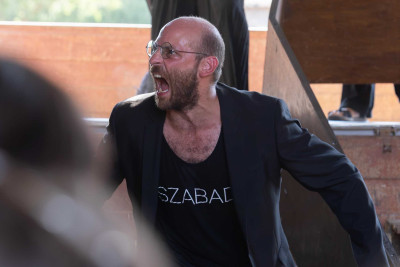
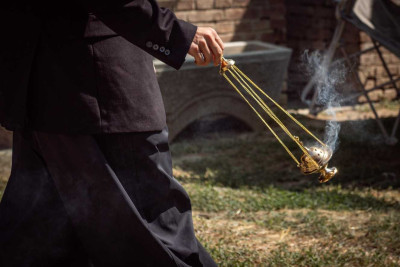
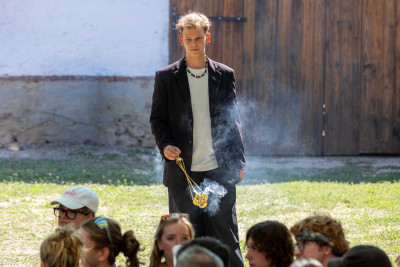
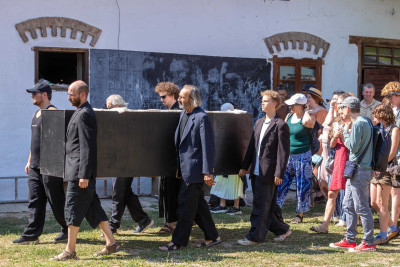
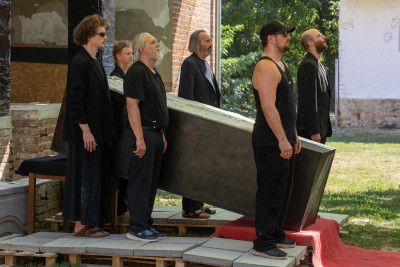
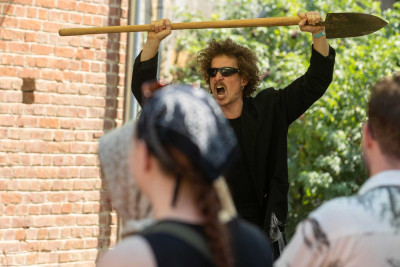
We invite the sons and daughters, colleagues and disciples of the ten-thousand-year-old Patriarchy to attend its funeral ceremony. “Let’s pick on men, let’s pick on the man within us. The father, the husband, the son. We finally want to be ‘just’ human beings, but deep down, our adolescent society keeps rumbling on, with its medieval institutions and transgenerational habits. For two years, we’ve been kneading the subject, and trying to push the patriarchy out of ourselves. We want to bury it, but first we have to kill it. Or embrace it.”
Critiquing patriarchy from a male perspective is almost taboo, a thought banished to men’s circles. And yet men’s circles themselves are still a rarity. At least in Hungary. But something is stirring. Mourning Patriarchy explores this subterranean movement, both in the earth and in the subconscious.
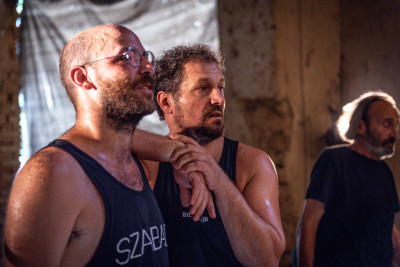
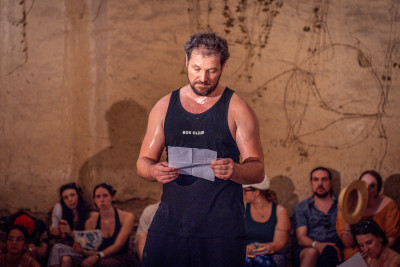
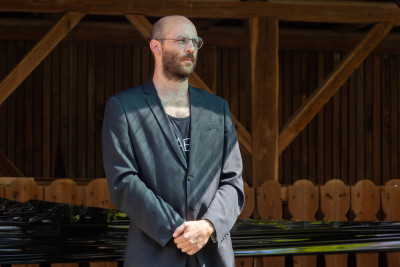
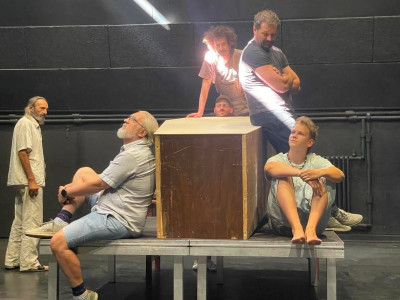
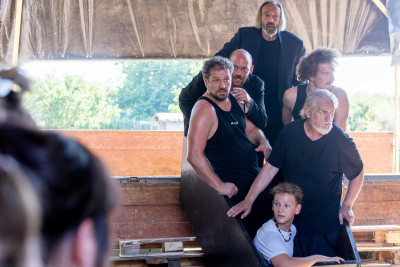
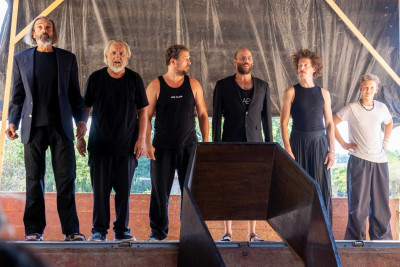
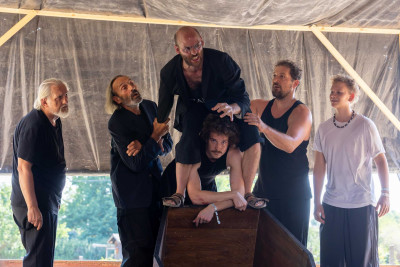
The crisis of contemporary masculinity is widely acknowledged, yet the responses to it vary enormously. On stage, six generations of men set out to confront the contradictions of the patriarchy within themselves and ultimately attempt to move beyond it. Artúr Bárdosi represents the generation in its twenties, Máté Kőrösi the thirties, Péter Valcz the forties, András Mészáros the fifties, Béla Szemán the sixties, and Sándor Téri the seventies. Together, they take part in a process of collective yet deeply personal transformation — a kind of mourning, perhaps — that the performance seeks to set in motion.
In creating the piece, the artists also seek to move beyond the rigid conventions of director-led theatre, actively exploring what theatre beyond patriarchy might look like. They keep returning to a series of questions: How can co-creators become truly equal? How can the dramaturgies of different art forms complement one another? How can self-reflection become part of the performance itself? And how can a performance become part of an ongoing social discourse?
Mourning Patriarchy is the culmination of a two-year creative process, shaped by a series of community events, including a Men’s Circle, a Vigil for Patriarchy at the 2025 Ördögkatlan Festival, and a Community Human Experiment, held at Trafó on Hungarian Men’s Day. A pre-premiere performance at the 2026 Ördögkatlan Festival was also an integral part of the process.
Petra Al-Farman is a dramaturg and screenwriter. She graduated in Hungarian Studies from Eötvös Loránd University (ELTE), and later earned degrees in theatre directing and dramaturgy from Freeszfe and the University of Theatre and Performing Arts Baden-Württemberg (ADK Ludwigsburg). Since 2018, she has been a member of the Soharóza choir. Her research focuses on choral theatre, as well as documentary and site-specific theatrical forms. As a dramaturg, she has worked on community-based theatre and musical performances, where collective creation and voice-based dramaturgy play a central role.
Máté Kőrösi is a documentary filmmaker. He graduated from the University of Theatre and Film Arts (SZFE), and his first feature-length film, Dívák (Divas), was produced by HBO and received awards at international film festivals. Alongside his own projects, he works as a freelance filmmaker and creative collaborator in independent theatre and music scenes. He is particularly interested in social awareness and the representation of reality through personal perspectives. He has collaborated with several civil organizations, including the Autonómia Foundation, Direkt36, and the Piros Orr Bohócdoktorok (Red Noses Clowndoctors).
Ernő Zoltán Rubik is a composer, pianist, and music educator. His work explores the relationship between improvisation, spatial sound, and sonic atmospheres. He is a regular collaborator in theatre and movement-based productions, blending classical and contemporary elements into meditative yet tension-filled musical structures.
Péter Valcz is an actor, director, and carpenter. After studying acting in Kaposvár, he trained at the international Jacques Lecoq school in Paris. He has worked with numerous companies in Hungary and abroad (including Paris, Ingolstadt, Cluj-Napoca, Debrecen, Szolnok, and Pune, India). His work is characterized by a human-centered approach, movement-based character building, humor, and social sensitivity. In 2025, he earned his MA degree with distinction in Theatre Studies at ELTE.

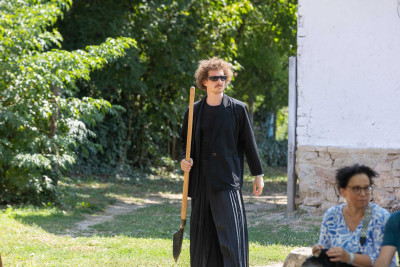
Petra Al-Farman is a dramaturg and screenwriter. She graduated in Hungarian Studies from Eötvös Loránd University (ELTE), and later earned degrees in theatre directing and dramaturgy from Freeszfe and the University of Theatre and Performing Arts Baden-Württemberg (ADK Ludwigsburg). Since 2018, she has been a member of the Soharóza choir. Her research focuses on choral theatre, as well as documentary and site-specific theatrical forms. As a dramaturg, she has worked on community-based theatre and musical performances, where collective creation and voice-based dramaturgy play a central role.
Máté Kőrösi is a documentary filmmaker. He graduated from the University of Theatre and Film Arts (SZFE), and his first feature-length film, Dívák, was produced by HBO and received awards at international film festivals. Alongside his own projects, he works as a freelance filmmaker and creative collaborator in independent theatre and music scenes. He is particularly interested in social awareness and the representation of reality through personal perspectives. He has collaborated with several civil organizations, including the Autonómia Foundation, Direkt36, and the Piros Orr Bohócdoktorok (Red Noses Clowndoctors).
Ernő Zoltán Rubik is a composer, pianist, and music educator. His work explores the relationship between improvisation, spatial sound, and sonic atmospheres. He is a regular collaborator in theatre and movement-based productions, blending classical and contemporary elements into meditative yet tension-filled musical structures.
Péter Valcz is an actor, director, and carpenter. After studying acting in Kaposvár, he trained at the international Jacques Lecoq school in Paris. He has worked with numerous companies in Hungary and abroad (including Paris, Ingolstadt, Cluj-Napoca, Debrecen, Szolnok, and Pune, India). His work is characterized by a human-centered approach, movement-based character building, humor, and social sensitivity. In 2025, he earned his MA degree with distinction in Theatre Studies at ELTE.
Performers: Artúr Bárdosi, Máté Kőrösi, András Mészáros, Ernő Zoltán Rubik, Béla Szemán, Sándor Téri, Péter Valcz
Concept: Petra Al-Farman, Máté Kőrösi, Ernő Zoltán Rubik, Péter Valcz
Set and Visual Design: Lőrinc Rácz
Video: Luca Hidegkuti Kardos
Music: Ernő Zoltán Rubik
Lighting: Ákos Papa Lengyel
Sound: Boldizsár Schramm
Production Manager: Brigitta Varga (Magnum Produkció)
Assistant Director: B. Marcell Bálint
Intimacy Coordinator: Bence Marczibál
Co-producers: Trafó House of Contemporary Arts, Magnum Produkció, Ördögkatlan Festival
Supported by: STAFÉTA Program – Municipality of Budapest, FÜGE, Tünet Együttes, Férfi Fonó
This production was created as part of the STAFÉTA Program launched by the Municipality of Budapest.
Special Thanks: Tamás Dávid-Barrett, Emcsi, Péter Halász, Dóra Djamila Mester, Péter Szil
 |
Budapest Főváros Önkormányzata |
 |
Staféta program |
 |
Tünet Együttes |
 |
Magnum Produkciós Iroda |
 |
KIM – Kulturális és Innovációs Minisztérium |