Installation on view: 18–26 September 2026, during focus events in Trafó’s main hall.
On 18 and 19 September free entrance.
From 20 September access with tickets to the focus events.
Accompanying program
On 18 September at 7:30pm as part of the opening of the installation, Justyna Stasiowska will perform live, playing a 40 minute concert on her multi-channel installation.From 8:30pm there will be an artist talk with the artists participating in the focus' opening: Iza Tarasewicz, Justyna Stasiowska, Cooking Sections, Csakoda group (Trapp Dominika, Dés Márton).
Eastern European folklore, ears of wheat, peasant barricades, agricultural tools freed from slavery—all of this in Trafó’s black and neat theater hall.
Iza Tarasewicz’s large-scale installation and Justyna Stasiowska’s soundscape truly take over the space: their work is both a celebration of rural life and communities, and a tribute to their strength and daily struggles.
“This is a metaphor for hardship – few people think of farm work as a competitive sport, yet it requires almost Olympic fitness and fortitude. My experiences growing up in the countryside and working side by side with my grandparents and parents evoke in me a nostalgia for communal effort. In that world, my childhood contribution was respected, and the work had a collective character.” (Iza Tarasewicz)
On 18 September from 7.30 pm, sound artist Justyna Stasiowska will perform live on her multi-channel sound installation and give a 40-minute concert as part of the focus’ opening event.
Her new sound piece, specially created for this occasion, is inspired by the (poly)rhythms of threshing and the interplay between the threshing floor and the theatre space. For Justyna, the threshing floor is an ‘empty space’ which – much like the theatre space in Peter Brook’s thinking – gains function and meaning through performative action.
The sound performance will be followed by an opening speech and an artist talk.
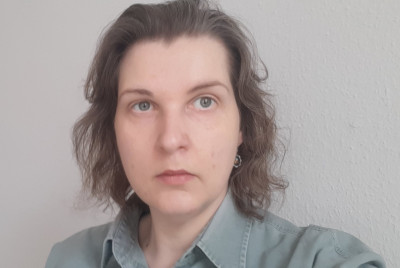
Iza Tarasewicz (1981) is an internationally recognized Polish visual artist who lives and works in Kolonia Koplany. Rooted in the agrarian traditions of the Podlaskie region and wider Eastern European folklore, her interdisciplinary practice spans sculpture, installation, drawing, and performance. She constructs her poetic installations—which engage with the materiality of the past while reflecting on the future—from parts of agricultural machinery and organic materials. She creates reconfigurable, modular constellations that function as flow systems for matter and energy, translating abstract diagrams and relational charts into tangible "figures of thought." These works combine raw functionalism with formal logics found in the natural world, agriculture, and scientific experimentation. Investigating the building of kinship in an era of hyper-individualism, she focuses on interdependence and solidarity—not only among people, but also with the more-than-human world.
Exhibited Artworks:
Iza Tarasewicz, Revelation of Powers, 2022, oxidized steel, various dimensions (32 pieces).
Iza Tarasewicz, Cluster of Contingencies IV, 2022, steel, various dimensions.
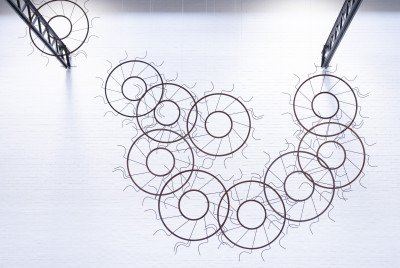
Iza Tarasewicz, Looped Processions V, 2022, oxidized steel, 500 × 800 × 150 cm, various dimensions of hanging.
In a historic milestone, in December 2026, Iza Tarasewicz will become the first female Polish artist to present a solo exhibition in the Ground Hall of the Vienna Secession. In 2027, she will participate in the prestigious Skulptur Projekte Münster in Germany. She has participated in numerous prestigious international biennials, including the 32nd Bienal de São Paulo (2016), the 11th Gwangju Biennale (2016), and the 40th EVA International – Ireland’s Biennial (2023). https://izatarasewicz.com/
Justyna Stasiowska (1987) is a lesbian silesian artist and theorist working through sound. Working in the field of sonic narration she focuses on notions of dramaturgy and design in different disciplines. Writes text and makes audio papers about performativity of sound perception. Creates installations and also works with choreographers, directors in fields of dance, theatre and film creating fakescapes in order to think how affective force of sound works in a medium.
https://jstasiowska.cargo.site/, https://soundcloud.com/justyna-stasiowska
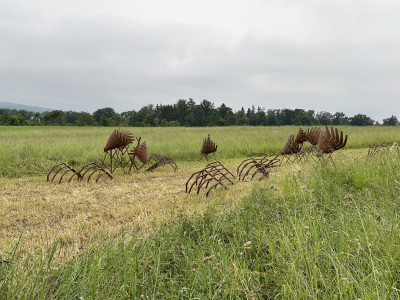
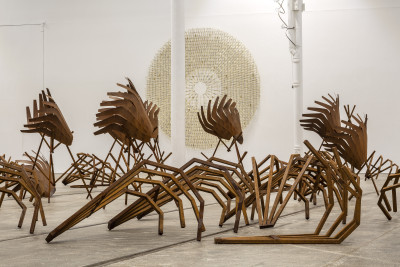
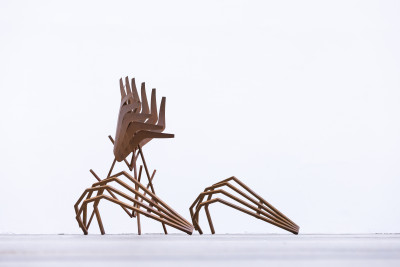
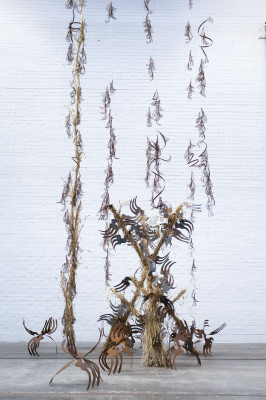

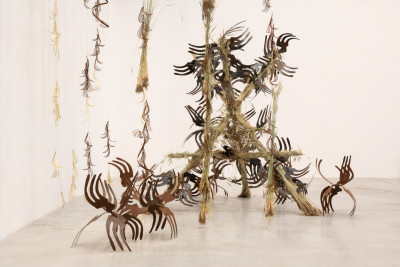
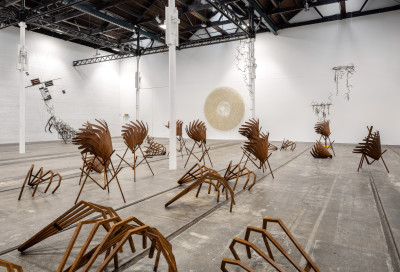
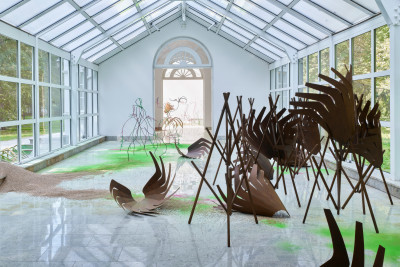
Iza Tarasewicz, Revelation of Powers, 2022, oxidized steel, various dimensions, 32 pieces.
In Looped Processions V, Iza Tarasewicz forgoes literalism in favor of a pure looping abstraction. Ten metal hoops—raw components of agricultural machinery—draw a rhythmic arrangement on a light wall, their geometry evoking the symbol of the Olympic rings. However, where the Olympic symbol suggests competition, Tarasewicz's interwoven links manifest interdependence: a system of interconnected vessels, in which each line finds support in the next. It is also an echo of archaic processions and the mazurka—a dance based on persistent repetition, where the individual dissolves into collective choreography.
“This is a metaphor for hardship – few people think of farm work as a competitive sport, yet it requires almost Olympic fitness and fortitude. My experiences growing up in the countryside and working side by side with my grandparents and parents evoke in me a nostalgia for communal effort. In that world, my childhood contribution was respected, and the work had a collective character.” (Iza Tarasewicz)
Sound contribution: Justyna Stasiowska
Light design: Kata Dézsi
 |
Lengyel Intézet |