How to Do Things?... In the Middle of (No)Where...BUDAPEST
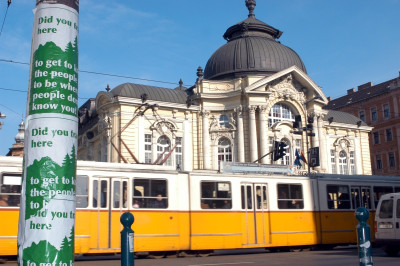
How to Do Things? – In the Middle of (No)where… has a process-based, dialectical structure. The project features artistic practices that—being less object-oriented—position themselves socially. The starting point and working material for the selected artists is the world, in which they live, move and act upon. The twenty-eight artists involved are invited on a residency grant to spend one month in a new, unfamiliar environment, to research and develop new projects that potentially refer to the different realities and contexts of a Europe that is, as yet, still very heterogeneous. The residencies take place in the European capitals of Budapest, Bucharest, Kiev, Copenhagen and Berlin, and are linked to exhibitions held at the local partner institutions and in public spaces.
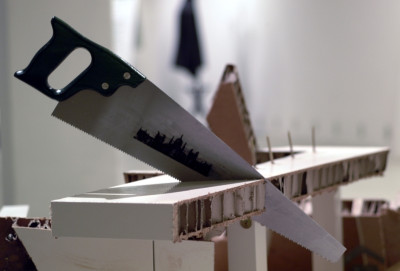
The first exhibition in the framework of How to Do Things? – In the Middle of (No)where…. takes place at Trafó – House of Contemporary Arts, February 1 – 26, 2006. It features partly new projects and partly older work by Andreas Fogarasi, Lise Harlev, Michal Moravčík, Julita Wójcik and Société Réaliste. Thus, beyond the artworks presented on the opening, during their one month stay, the artists will develop a truly new project as a reaction to their experiences gained in Budapest. As a local artist mediator, Miklós Erhardt will be in dialogue with the artists throughout the realization of the projects. Although these works might take place in public spaces and therefore won't be incorporated in the exhibition, the artists will present their thoughts and the process of their work to the audience on February 18, at 4pm.
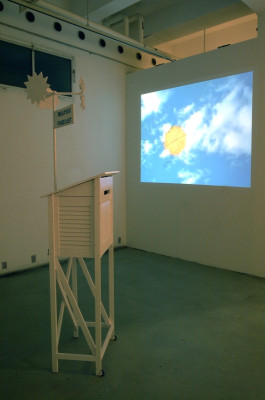
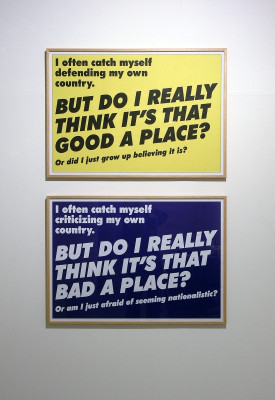
In the exhibition Julita Wójcik shows one of her video-performances: Pust wsjegda budjet solnce (May always be sunshine) (2004), a title taken from a soviet pioneer song; in the video Wójcik refers to the motto of the song by simply having a kite with the symbol of the sun flying in the bright sky; her Budapest project Weather Forecast (2006) invites the public to vote for tomorrow’s weather, that is, the weather one would like to have on the coming day; with this project the artist is reacting to a situation in Budapest that is strongly shaped by the Hungarian 2006 election campaign. Among the themes in the elections campaign is the question of the nation and its borders, Michal Moravčík 's works comments upon nationalism as well as on problems of political power, society and the individual in general. During his residency he will work on the issue of minorities and their representation. Lise Harlev's artworks relate to the phenomena of advertising in public space – applied for commercial purposes just as for political campaigns – and invite the viewer to reflect upon the consumption of these messages; for her posters the artist playfully appropriates simple and colourful images and typefaces from advertisements and billboards; Harlev's Budapest project examines the emotional implications of travelling abroad and the resulting problems of identification and self-understanding. In his works Andreas Fogarasi deals with the question of how economic models interfere and produce images and concepts of space; Displaying a left (2001), on show at Trafó, evolves around the headquarters of the communist party in Paris built by Oscar Niemeyer. The artist uses this exemplary modernist building to reflect upon questions of linking aesthetics to political commitment and of constantly changing modes of interpretation. Fogarasi will investigate the transformation that the \Művelődési Házak\ (cultural centers) in Budapest went through since their construction in the 1950s. The artist group Société Réaliste (Ferenc Gróf & Jean-Baptiste Naudy del Fat) presents its project Ponzi's (2006) for the first time; the title refers to a type of illegal pyramid scheme named after Charles Ponzi and the installation comments on the specific form of wild capitalism in ex-socialist Europe. Ponzi's will travel to all five exhibition venues in a locally-adapted form, showing the very heterogeneous views not only on economic models, but also on the art market in all five countries. Société Réaliste will give a talk on the opening evening, February 1, 2006. All the artists will be present for the opening. The final How to Do Things? – In the Middle of (No)where… exhibition in Berlin (September 1 – October 8, 2006) will offer a comprehensive view of the complete project presenting works by all the participating artists and will be accompanied by a catalogue in English providing documentation of the entire project.
produced by uqbar supported by Culture 2000; The National Cultural Fund, Hungary; European Cultural Foundation; Allianz Kulturstiftung, Auswärtiges Amt/ifa